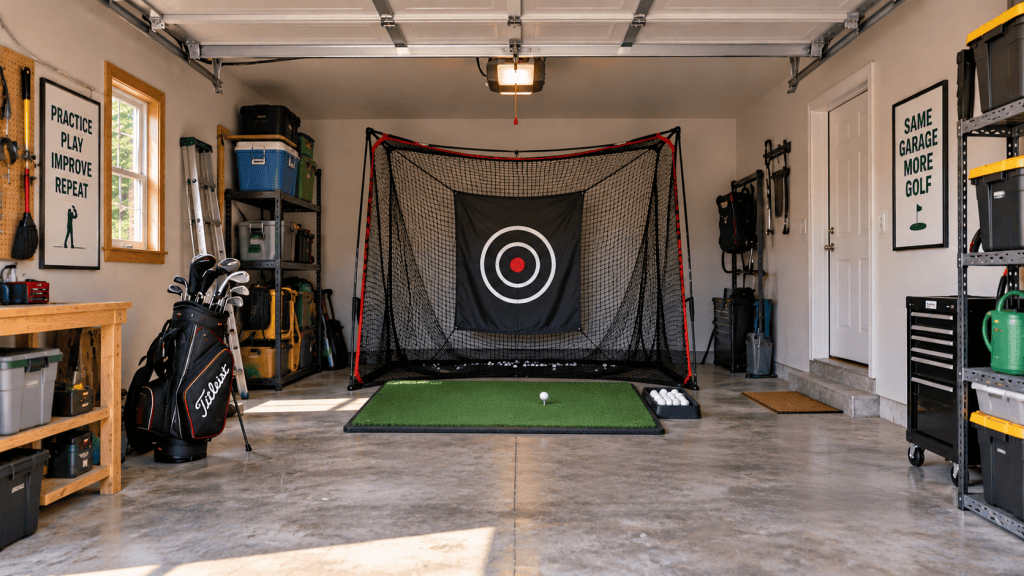
A permanent golf setup sounds wonderful until Tuesday morning, when you remember the garage was originally designed for something called a car.
If this is your only parking space, I’d put pack-away time surprisingly high on the shopping list. A net that’s reasonably easy to put up and take down will probably get used. One that requires a minor construction project every Saturday may eventually become a very expensive place to hang jackets.
So we’re not trying to build the ultimate home golf simulator here.
We’re answering a more practical question:
What do you actually need to practice full swings in a single-car garage without permanently turning the garage into a golf room?
I’ve put together three setups at roughly $235, $540 and $1,239. The first simply gives you a legitimate place to hit real balls. The second is the best balance in our current research for someone who expects to practice regularly. The third adds shot data—but only for the golfer who will actually use it.
And if your garage doesn’t pass the basic space-and-safety test, I wouldn’t buy any of them.
Affiliate disclosure: This article may contain affiliate links. If you purchase through one, we may earn a commission at no additional cost to you. These are research-based setup recommendations using manufacturer specifications, independent and owner evidence where useful, and our own space, cost and pack-away criteria. We have not personally hands-on tested every product discussed below.
Prices checked September 2, 2026. Temporary sales and product terms can change.
First: Can You Safely Make a Full Swing?
Ceiling height matters, but “my garage has a nine-foot ceiling” doesn’t answer the whole question.
Garage-door tracks count. Lights count. The opener hanging over the middle of the room definitely counts, whether the tape measure finds that fair or not.
Before shopping, stand in the exact place where you expect the ball to sit and make several slow swings with the longest club you intend to use. Gradually work toward a normal swing while checking your backswing, follow-through and everything hanging above or sitting beside you.
For these three full-swing setups, we would not recommend an under-eight-foot space. Nine feet goes into the conditional category rather than automatically receiving a green light. Golfer height, club length, swing shape and the actual garage layout matter too.
That’s an editorial filter for these setups—not a universal rule claiming every golfer needs exactly the same ceiling.
The useful rule is simpler:
Swing first. Shop second.
What We Mean by “Pack-Away”
Manufacturers use the word portable pretty generously.
Technically, your dining-room table is portable if enough people arrive.
For this site, we’re using a more practical standard.
A Daily Pack-Away setup should be something one golfer can realistically return to parking mode in about five minutes without tools or major disassembly.
That is our standard, not a manufacturer certification. Until we’ve personally timed a particular product or have enough reliable evidence to do so confidently, we’ll treat individual pack-away classifications as provisional.
There’s portable, and then there’s I’m actually willing to put this thing away on Wednesday night.
The Spornia SPG-7 is especially promising here. Spornia describes it as a quick-setup, folding net with automatic ball return; it measures roughly 7 × 7 × 7 feet plus its roof section and weighs 20 pounds.
The less expensive GoSports 7×7 takes a more conventional portable-net approach. GoSports currently lists it at $79.99 and positions it for home, indoor and garage practice.
That gives us two different ways into the same basic problem.
Build #1: Just Hit Balls — About $235
This is where I’d start if the question is simply:
Can I hit real golf balls in my garage without spending $500?
The setup:
- GoSports 7×7 hitting net — $79.99
- GoSports PRO 5×4, 15 mm hitting mat — $129.99
- GoSports shank-net attachment — $24.99
Total: $234.97 before tax.
GoSports currently lists those prices on its own site. The 15 mm PRO mat is a full-stance mat that the company rates for approximately 75,000 shots; that number is a manufacturer durability claim, not an independently verified lifespan.
And I intentionally included the shank net.
Sure, I could knock $24.99 off the headline price by leaving it out.
I could also pretend I’ve never hit a golf ball sideways.
GoSports says the attachment fits its 7×7 and 10×7 nets, can attach on either side for a right- or left-handed golfer, and recommends two when both sides need protection at the same time.
Notice that I said protection, not a guarantee that every bad shot will be contained. If a window, vehicle, person or finished wall remains realistically reachable, you may need more coverage—or this may not be a sensible place for full swings at all.
You don’t need ball speed, spin axis and a computer-generated tour of Pebble Beach to work on whether you’re finding the middle of the clubface.
Sometimes you just need somewhere to hit 40 balls without putting one through the garage drywall.
Who should buy Build #1?
The golfer who wants repetitions, contact practice and a relatively inexpensive way to hit real balls at home.
Who should skip it?
Someone expecting heavy, frequent practice who already knows he wants a more substantial net and practice surface.
And if you already own a perfectly adequate mat or net, keep it. These builds are frameworks, not matching furniture sets. Replace the weak part rather than buying everything again because our spreadsheet happened to put three products in the same row.
Build #2: Everyday Garage Range — About $540
This is the one I like best for a golfer who expects to practice several times per week.
Not because it’s more expensive.
Because the extra money is going toward the two pieces doing most of the work.
The setup:
- Spornia SPG-7 — $349.99 regular price
- GoSports ELITE 5×4, 15 mm mat — $149.99
- Spornia SPG-7 side extension — $39.99
Regular-price total: $539.97.
Spornia currently lists the SPG-7 at $349.99. It supports real balls and every club including driver, folds for storage and uses an automatic ball-return design.
The SPG-7 version of Spornia’s side extension is $39.99. Spornia says the extension is intended to add coverage for shanks and off-target shots, particularly in garages and other tighter spaces; extensions are sold individually.
The GoSports ELITE 5×4 is currently $149.99 with 15 mm foam backing. GoSports rates its turf for approximately 150,000 shots—again, their figure, not ours.
For regular practice, that combination makes more sense to me than immediately buying electronics.
The net receives every shot.
The mat receives every club strike.
Those are pretty important job descriptions.
If you’re only going to hit balls occasionally, save the money and buy Build #1. I don’t think the typical occasional golfer needs to spend another $300 just because we can find a way to justify it.
For someone using the garage several times a week, though, Build #2 is the best balance in our current research between equipment quality and the ability to make the garage look like a garage again afterward.
Build #3: Add Useful Shot Data — About $1,239
Build #3 is simple:
Take Build #2 and add the Square Golf Home Edition launch monitor — $699.
Total: $1,238.97.
Now the important part:
Most golfers reading this article do not need Build #3.
If your main goal is to make regular swings, improve contact and get meaningful repetitions during a Midwest winter, Build #1 or #2 can do that without another $699 leaving your bank account.
Buy the Square only if shot data will materially change how you practice.
That might mean you want feedback on ball flight and club delivery, enjoy structured practice with numbers, or eventually want to add simulation features.
Square currently lists the Home Edition at $699 and advertises no subscription fee plus 1,000 included credits. It uses high-speed camera technology, includes three dedicated marked balls and supports club markers for additional club information. Its current product information also lists an eight-hour battery. Software and credit terms can change, so those are facts we’d recheck periodically rather than promise forever.
For this particular garage setup, the interesting part is where Square sits.
It uses a compact side-mounted arrangement rather than needing several feet of empty space behind the golfer. Square’s own manual defines the Home Edition hitting area relative to the monitor—a 15 cm square zone whose center is 42 cm forward and 23 cm to the right of the unit.
That makes it much easier to fit into a constrained-depth garage than some rear-radar systems.
No projector required.
No impact screen required.
No permanent enclosure required.
You can add useful shot data before you build Augusta National in your garage.
One caution for mixed-handed households
Because Square sits beside the hitting area, switching between right- and left-handed golfers means repositioning the monitor. Independent setup guidance specifically calls this out; marking repeatable positions on both sides is one practical way to manage it.
So a household with both righties and lefties should plan for two-sided miss protection plus Square repositioning.
That doesn’t make Square a bad choice.
It simply belongs in the decision.
Why Garmin R10 Isn’t Our Default Garage Recommendation
The Garmin Approach R10 is a good example of why we don’t want to build this site around generic “best product” lists.
Garmin specifies a minimum indoor area of 15 feet long × 8 feet wide × 8 feet high. It calls for the R10 to sit 6–8 feet behind the ball, with the ball at least 8 feet from the net or impact screen. Garmin also notes that metal and concrete objects can affect radar performance indoors.
That can work perfectly well in the right room.
But it fights the premise of this article:
single-car garage + limited depth + needs to disappear afterward.
If you’ve got sufficient depth and also want a launch monitor you can take outdoors or to the range, the R10 becomes much more interesting.
That’s the distinction we’re after.
Not:
What’s the best launch monitor?
But:
What’s the best fit for this golfer, in this room, for this purpose?
Adding an R10 is easy.
Finding the extra garage behind you is harder.
The Concrete-Floor Problem
Here’s another detail the glossy simulator photos tend not to emphasize:
The floor underneath all this stuff is probably concrete.
Both GoSports mats we’re using have 15 mm foam backing, and GoSports describes that thickness as providing additional forgiveness on mishits.
That does not mean we’re claiming a 15 mm mat prevents injuries, nor that every golfer needs an expensive premium hitting mat.
It means something simpler.
If you’re repeatedly striking balls while standing on and hitting over a hard concrete slab, the feel and forgiveness of the hitting surface deserves more attention than it might on a softer underlying floor.
That’s enough of an issue that I think it deserves its own article rather than pretending we’ve settled the entire mat question here:
Best Golf Mats for a Concrete Garage Floor — That You Can Still Put Away
And that final phrase matters.
The softest, most luxurious mat on Earth isn’t automatically the right garage mat if moving it every evening becomes its own workout.
When I Would Buy None of These
This may be the most important section on the page.
I would not buy one of these full-swing setups if:
- you cannot establish comfortable swing clearance with your longest intended club;
- windows, cars, people or other hazards remain realistically reachable and you cannot provide adequate containment;
- the garage is so tight that using the setup requires an awkward or compromised swing;
- or you already know that putting everything up and away will be such a nuisance that you’ll stop using it.
There is no prize for successfully owning a golf net.
If your ceiling is too low for full swings but you have enough room for putting, chipping or smaller swing-training work, build that setup instead.
If your garage simply isn’t a good place to hit real balls, use the driving range.
Spending zero dollars is allowed.
In fact, eventually I want our recommendation tool to be capable of returning exactly that answer:
None of these.
Which Setup Makes Sense?
| Setup | Cost | Best for | Skip it if… |
|---|---|---|---|
| Just Hit Balls | $235 | Budget or occasional practice | You expect heavy/frequent use and already want better core equipment |
| Everyday Garage Range | $540 | Regular weekly practice | You’ll only use it occasionally |
| Add Useful Shot Data | $1,239 | Golfers who genuinely use feedback/data | Numbers won’t actually change how you practice |
For the occasional golfer, I’d start with Build #1.
For someone expecting to practice several times per week, Build #2 is our current recommendation.
And Build #3?
Don’t buy the Square because $1,239 makes the setup look more impressive.
Buy it because you can explain exactly what you’re going to do with the information it gives you.
Before You Buy: The 60-Second Garage Check
Take your longest club into the garage.
Stand where the ball will actually sit.
Swing it.
Check the ceiling, lights, opener, door tracks and open garage door. Look behind you. Look beside the net. Measure the usable depth and width—not merely the room dimensions listed on the house plan.
Decide what needs protection.
Decide whether everything needs to come down nightly.
And take inventory before ordering anything. If you already own a suitable mat, net or other component, use it.
Then choose the setup.
Or don’t.
Measure twice. Buy the net once.
 Space First Golf